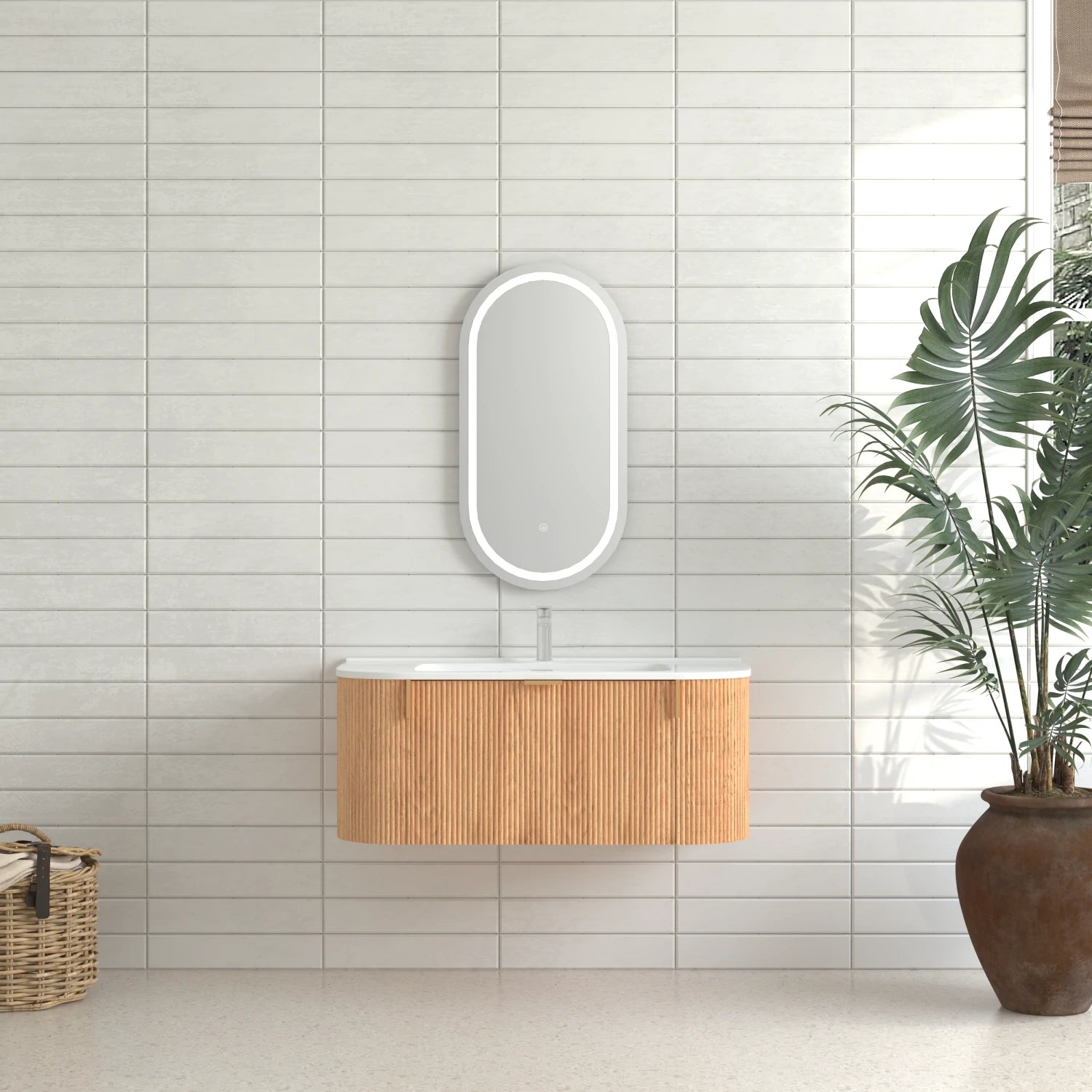
How to Choose the Right Bathroom Vanity (Complete Buying Guide)
Lead In
When choosing a bathroom vanity, I recommend not starting with “whether it looks good,” but judging it in this order:
Whether the size fits → whether the type suits the space → whether the material is moisture-resistant → whether the storage is enough → whether the sink/faucet matches → whether the style is coordinated → whether the budget is reasonable → in-store quality inspection.
1. How to Confirm Whether the Bathroom Vanity Size Is Suitable?
Bathroom vanity sizing is not only about “whether the wall width is enough.” You also need to consider front clearance, door/drawer opening space, distance from the toilet/shower area, and plumbing location. The NKBA bathroom planning guidelines recommend that the clear space in front of fixed fixtures such as the vanity, toilet, and bathtub should ideally be at least 30 inches, with a minimum requirement usually around 21 inches; the centerline of the sink should ideally be at least 20 inches from a side wall, with a minimum requirement of 15 inches. These dimensions directly affect whether the bathroom vanity can be used comfortably.
Size Confirmation Steps
| Item to Check | How to Judge | Key Notes |
|---|---|---|
| Available wall width | Measure the actual usable distance between side walls, door frames, toilet, and shower enclosure | Do not only look at the total wall width |
| Cabinet width | Small bathrooms can use 18–24 in; common single-sink vanities are often 30–48 in; double-sink vanities are usually 60 in or above | For double sinks, consider the center distance between the two basins |
| Cabinet depth | Standard depth is often around 18–22 in; narrow models are available for small spaces | Too much depth will reduce walking space |
| Countertop height | Common comfortable height is usually around 32–36 in; for vessel sinks, the sink height must also be included | A vessel sink + tall cabinet may become too high |
| Front clearance | Check whether standing, bending, and opening drawers are comfortable | Do not let the door, toilet, or shower door block it |
| Drawer/door opening | Check whether drawers hit the toilet, wall, or bathroom door when pulled out | In the showroom, fully pull out the sample drawers to test |
| Plumbing position | Check whether the drain pipe and hot/cold water lines will interfere with drawers | This is especially important for drawer-style vanities |
A simple way to judge: For a very small bathroom, prioritize walkway clearance; for a medium bathroom, prioritize storage; for a large primary bathroom, consider double sinks, a longer countertop, and stronger design impact.

2. How to Choose the Right Bathroom Vanity Type?
1) Corner Vanity
Suitable for: small bathrooms, guest bathrooms, powder rooms, and spaces where a corner is difficult to use.
The advantage is that it saves space and makes use of dead corners; the disadvantage is that the countertop area and storage space are usually smaller, and there are fewer style options. If the bathroom is very compact and you only need basic handwashing and a small amount of storage, a corner vanity is feasible. But if it is a primary bathroom or used by multiple people, I do not recommend it as the first choice.
2) Wall-Mounted / Floating Vanity
Suitable for: modern-style bathrooms, small apartments, and designs that want the space to feel lighter and more open.
The biggest advantage of a wall-mounted vanity is that it looks more open visually, the floor is easier to clean, and it enhances the modern feel. The disadvantage is that installation requirements are higher. The wall needs enough load-bearing capacity, and it is best to confirm whether there is reinforced structure inside the wall in advance. If a wall-mounted vanity is not installed securely, problems such as loosening, sagging, and wall cracking may occur later.
When choosing a wall-mounted vanity, focus on three points: wall load-bearing capacity, mounting hardware, and whether the drain pipe can be hidden neatly.
3) Freestanding Vanity
Suitable for: most homes, renovation projects, and bathrooms where you want easier installation and stronger storage.
A freestanding vanity is the safest choice. It is easier to install, usually provides more storage space, and has lower requirements for the wall. For ordinary homes, rental properties, renovation company projects, and standard residential bathrooms in the U.S. market, a freestanding vanity is often the most cost-effective and lowest-risk option.
Vanity Type Selection Suggestions
| Bathroom Scenario | Recommended Type |
|---|---|
| Extremely small powder room | Corner vanity / narrow floating vanity |
| Small apartment bathroom | Floating vanity / 24–30 in freestanding vanity |
| Regular family guest bathroom | 30–36 in freestanding vanity |
| Primary bathroom | 48–72 in freestanding vanity or double-sink vanity |
| Modern minimalist style | Wall-mounted vanity |
| Strong focus on stability and storage | Freestanding vanity |
| Limited budget | Standard-size freestanding vanity |

3. What Material Should You Choose for a Bathroom Vanity?
The core of a bathroom vanity is not “whether it looks like wood,” but whether it can withstand humidity, water vapor, cleaning agents, and daily use over the long term. Common cabinet body materials include solid wood, plywood, MDF, and particle board; common countertop materials include quartz, solid surface, ceramic, sintered stone, and natural stone.
Cabinet Body Material Suggestions
| Material | Advantages | Disadvantages | Recommendation |
|---|---|---|---|
| Plywood | Good stability, relatively good moisture resistance, high strength | Costs more than ordinary MDF/particle board | Top recommendation |
| Moisture-resistant MDF | Smooth surface, suitable for painted finish and veneer, moderate price | Poor edge sealing can lead to swelling after water absorption | Can be chosen, but check edge banding and coating |
| Solid Wood | Good texture, premium look | High price; humidity changes may cause deformation | Suitable for high-end products or solid wood frames |
| Particle Board | Low cost | Weaker moisture resistance and screw-holding strength | Not recommended for long-term humid environments |
| PVC/aluminum alloy/stainless steel | Strong waterproof performance | Limited style options, weaker home-like feel | Suitable for special high-humidity scenarios |
My suggestion is: for mid-to-high cost performance, choose “plywood cabinet body + moisture-resistant edge sealing + quartz/ceramic/integrated sink countertop.”
If the budget is limited, moisture-resistant MDF can also work, but you must check whether the edge banding, bottom panel, back panel, and cutout areas have been moisture-proofed.
Countertop Material Suggestions
| Countertop Material | Suitable Users | Evaluation |
|---|---|---|
| Quartz | Those who want durability, easy cleaning, and good texture | Strong overall performance and good cost performance |
| Ceramic integrated sink | Small bathrooms, guest bathrooms, budget-friendly projects | Easy to clean, fewer seams |
| Solid surface | Modern clean style | Unified appearance and easy maintenance |
| Natural marble | High-end design bathrooms | Beautiful but requires more maintenance |
| Sintered stone | Modern premium style | High-end appearance, but processing and installation quality matter |

4. How to Choose the Style?
Style should not only be judged by a single bathroom vanity. You need to look at the whole bathroom: tiles, walls, flooring, mirror cabinet, lighting, hardware, and faucet color.
Common Style Choices
| Style | Suitable Pairing | Vanity Suggestions |
|---|---|---|
| Modern | Large-format tiles, recessed lighting, LED mirror | Flat-panel doors, floating vanity, black/white/wood tones |
| Transitional | Most American homes | Shaker doors, white/gray/walnut |
| Minimalist | Small spaces, clean design | Handle-free, light colors, wall-mounted vanity |
| Farmhouse | White walls, vintage lights, metal handles | Shaker doors, oak color, white countertop |
| Luxury | Marble texture, gold hardware | Dark cabinet body, sintered stone/quartz countertop |
| Natural | Wood-look tiles, beige tones | Oak, light walnut, rattan/fluted elements |
The safest choices are: white, light wood, gray, and walnut.
If the bathroom is small, choose light colors or a floating vanity; if the bathroom has good natural light, you can choose a dark cabinet body to create a more premium feeling.

5. Do You Need to Consider Storage Space? What Factors Should Be Considered?
Yes, and it is very important. Many bathroom vanities “look large,” but because of the drain pipe, sink depth, and unreasonable internal shelf design, the truly usable space may not be much.
Storage Needs Depend on These Factors
-
Number of users
For one person, 24–30 in may be enough; for two people using it long-term, 36–60 in or above is recommended. -
Types of items
Toothbrushes, skincare products, hair dryers, curling irons, towels, cleaning products, and tall shampoo/cleanser bottles all require different storage space. -
Drawers vs. cabinet doors
Drawers are better for daily small items, while cabinet doors are better for tall bottles, cleaning supplies, and extra toilet paper. -
Whether plumbing takes up space
If the drain pipe is in the middle, regular drawers may be cut off. You can choose U-shaped drawers or an offset drain design. -
Whether appliance storage is needed
If you need to store a hair dryer, electric toothbrush, or shaver, it is best to consider an internal outlet or an outlet near the mirror cabinet.
Recommended Storage Configurations
| Use Scenario | Recommended Configuration |
|---|---|
| Small guest bathroom | Single-door cabinet + 1 drawer |
| Regular family bathroom | 2–3 drawers + lower cabinet |
| Primary bathroom | Multiple drawers + double-door cabinet + long countertop |
| More skincare/makeup items | Multiple shallow drawers are more practical |
| More cleaning products | Keep a taller cabinet space |

6. How to Choose the Sink and Faucet?
Sink Types
| Sink Type | Advantages | Disadvantages | Suitable Scenario |
|---|---|---|---|
| Undermount Sink | Easy to clean, complete countertop surface, premium look | Higher installation requirements | Mid-to-high-end bathrooms |
| Integrated Sink | Fewer seams, easy to clean, budget-friendly | Styles are relatively fixed | Guest bathrooms, small bathrooms |
| Vessel Sink | Strong shape and design impact | Easy to splash; height must be controlled | Design-focused bathrooms |
| Drop-in Sink | Easy installation | Rim can collect dirt | Budget projects |
For ordinary home use, I recommend: an undermount sink or an integrated sink.
If you care more about design effect, you can choose a vessel sink, but you must calculate the total height.
Key Points for Faucet Selection
-
Check the countertop hole configuration first
Faucets include single-hole, 4-inch centerset, 8-inch widespread, wall-mounted, and other types. They must match the countertop holes. Lowe’s bathroom vanity filters also classify options by faucet hole type such as single hole and 8-in centerset, which shows that hole compatibility is a key condition when buying. -
Check spout height and reach
Vessel sinks need tall faucets; undermount sinks or integrated sinks can use standard-height faucets. If the faucet is too high or the water outlet extends too far outward, it can easily splash. -
Check finish color
Black, brushed gold, chrome, and nickel are all common. It is recommended to keep them consistent with the mirror, lighting fixtures, door handles, and towel bars. -
Check the cartridge and aerator
A good faucet depends on smooth cartridge operation, stable water flow, surface plating quality, and whether it is easy to clean water stains.

7. Which Budget Range Currently Offers the Best Value?
Using the U.S. retail market as a reference, bathroom vanity prices vary greatly. Entry-level products are around $100–$500, mid-range products are commonly $600–$1,500, and high-end products can reach $2,000–$5,000 or more. On retail platforms such as Home Depot and Wayfair, mainstream 30–60 in bathroom vanities can also be seen ranging from several hundred dollars to over one thousand dollars.
The Range I Think Is Most Worth Buying
Single-sink 30–48 in: around $700–$1,300 offers the best cost performance.
In this range, you can usually get a product with a good appearance, relatively complete countertop configuration, and more stable hardware and cabinet quality.
Double-sink 60–72 in: around $1,200–$2,200 is more reasonable.
Double-sink vanities below this price often reduce costs in board material, countertop thickness, hardware, coating, or packaging.
Budget Suggestions
| Budget | What You Can Buy | Recommendation |
|---|---|---|
| $300–$600 | Small sizes, basic MDF/particle board, many integrated sink options | Suitable for temporary use or guest bathrooms |
| $700–$1,300 | Mainstream 30–48 in models with balanced appearance and configuration | Most recommended cost-performance range |
| $1,300–$2,500 | Better countertop, hardware, board material, and design | Suitable for primary bathrooms and long-term use |
| $2,500+ | High-end materials, custom sizes, brand premium | Suitable for high-end renovation |
True cost performance is not about buying the lowest price, but about getting these configurations: moisture-resistant cabinet body, reliable edge banding, quartz/ceramic/high-quality solid surface countertop, smooth hardware, reasonable storage, reliable after-sales service and packaging.
8. If Buying from an Offline Physical Store, How Should You Check Quality Before Buying?
The biggest advantage of buying offline is that you can directly inspect the details. I recommend checking in the following order:
1) Check the Cabinet Structure
Open the cabinet doors and look at whether the internal board thickness, back panel, bottom panel, and side panels are solid. Gently shake the cabinet body. If the whole cabinet feels loose or shakes obviously, it is not recommended.
Focus on:
- Whether the board edges are fully edge-banded
- Whether cutout areas have waterproof treatment
- Whether the bottom panel is weak
- Whether the back panel is too thin
- Whether the cabinet body is obviously deformed
2) Check Door and Drawer Gaps
A good cabinet should have even door gaps and drawer gaps, with consistent height on both sides. After pulling out a drawer, it should not wobble side to side, and it should close smoothly.
Key checks:
- Whether the door panels are uneven
- Whether the drawer rubs or scrapes
- Whether one side of the gap is larger than the other
- Whether the hinges are soft-closing
- Whether the slides are smooth and quiet
3) Check Hardware Quality
Hardware is the key to the lifespan of a bathroom vanity. In the store, open and close the cabinet doors and drawers 5–10 times repeatedly to feel whether they are smooth and whether there is any abnormal noise.
Focus on:
- Hinge thickness and rebound
- Slide smoothness
- Drawer load-bearing feeling
- Whether the handles are loose
- Whether screw holes are rough or cracked
4) Check the Countertop and Sink
Touch the countertop edge with your hand to see whether it feels sharp or uneven. Observe whether the sink glaze has black spots, pinholes, cracks, or uneven areas.
Focus on:
- Whether the countertop has cracks
- Whether the sink glaze is smooth
- Whether the drain hole is centered
- Whether the overflow hole is neat
- Whether the joint between countertop and sink is well sealed
5) Check the Surface Finish
For the vanity surface, do not only look at the color. Check whether the paint surface is even, and whether there is orange peel texture, particles, sagging, or bubbling.
Key checks:
- Whether corners expose the base material
- Whether door panel edges are bubbling
- Whether there are scratches on the surface
- Whether wood veneer edges are lifting
- Whether dark cabinet surfaces easily leave fingerprints
6) Smell for Odor
If the cabinet has a strong pungent smell, the glue, board material, or coating may have problems. A slight new-furniture smell is acceptable, but a pungent, eye-irritating smell that does not fade should be treated with caution.
7) Ask Clearly What Accessories Are Included
The display price of many bathroom vanities may not include everything. Before buying, ask clearly:
- Is the countertop included?
- Is the sink included?
- Is the faucet included?
- Is the drain assembly included?
- Is the mirror included?
- Is the backsplash included?
- Does it require assembly?
- Is delivery included?
- Is there a damage return/exchange policy?
- How long is the warranty?

9. Final Summary: How to Choose the Safest Option?
For ordinary households choosing a bathroom vanity, you can follow this conclusion:
First, measure the size.
Do not only look at width. Also check front clearance, door and drawer opening, toilet distance, shower door, and plumbing location.
Second, prioritize the right type.
For small spaces, choose a narrow model or wall-mounted vanity; for regular bathrooms, choose a freestanding vanity; for primary bathrooms, choose a large double-sink vanity; only consider a corner vanity when the space is truly a corner layout.
Third, material is more important than appearance.
For long-term use, prioritize plywood, moisture-resistant MDF, solid wood frames, reliable edge banding, and durable countertops.
Fourth, storage must be truly usable.
Drawers are more convenient than simply having large cabinet doors, but they must avoid the drain pipe position.
Fifth, the sink and faucet must match.
Countertop hole configuration, faucet height, spout reach, drain assembly, and overflow hole all need to be confirmed.
Sixth, do not push the budget too low.
At present, it is better to place the budget in the mid-range: single-sink $700–$1,300, double-sink $1,200–$2,200. This range is more likely to balance appearance, material, hardware, and service life.
In one sentence: The right bathroom vanity is not the most expensive one, nor the best-looking one, but the one with the right size, moisture-resistant material, enough storage, matching sink and faucet, low installation risk, and easy long-term maintenance.
Produits phares


AISU 36" Bathroom Vanity with Sink, Wall-Mounted Floating Plywood Bathroom Storage Cabinet with 2 Drawers, White Ceramic Basin, NO Faucet, Pre-assembled, Natural Woodgrain Color
- $742.41
- $742.41
- Prix unitaire
- par


AISU 30" Bathroom Vanity with Sink, Wall-Mounted Floating Plywood Bathroom Storage Cabinet with 2 Drawers, White Ceramic Basin, NO Faucet, Pre-assembled, Retro Walnut Woodgrain Color
- $558.56
- $558.56
- Prix unitaire
- par


AISU 30" Bathroom Vanity with Sink, Wall-Mounted Floating Plywood Bathroom Storage Cabinet with 2 Drawers, Carrara White Basin, NO Faucet, Pre-assembled, Retro Walnut Woodgrain Color
- $582.67
- $582.67
- Prix unitaire
- par


AISU 30" Bathroom Vanity with Sink, Wall-Mounted Floating Plywood Striped Bathroom Storage Cabinet with 2 Drawers, White Rectangle Ceramic Basin, NO Faucet, Pre-assembled, Natural Woodgrain Color
- $554.67
- $554.67
- Prix unitaire
- par


AISU 36" Bathroom Vanity with Sink, Wall-Mounted Floating Plywood Bathroom Storage Cabinet with 2 Drawers, White Ceramic Basin, NO Faucet, Pre-assembled, Retro Walnut Woodgrain Color
- $742.41
- $742.41
- Prix unitaire
- par


AISU 24" Bathroom Vanity with Sink, Wall-Mounted Floating Plywood Striped Bathroom Storage Cabinet with 2 Drawers, White Rectangle Ceramic Basin, NO Faucet, Pre-assembled, Natural Woodgrain Color
- $519.25
- $519.25
- Prix unitaire
- par


AISU 24" Bathroom Vanity with Sink, Wall-Mounted Floating Plywood Bathroom Storage Cabinet with 2 Drawers, White Ceramic Basin, NO Faucet, Pre-assembled, Retro Walnut Woodgrain Color
- $521.01
- $521.01
- Prix unitaire
- par


AISU 36" Bathroom Vanity&Sink, Floating Stripe Plywood Storage Cabinet with 2 Drawers, Carrara White Sintered Stone Hot-bent Integrated Rectangle Basin, Pre-assembled, Retro Walnut Woodgrain Color
- $667.09
- $667.09
- Prix unitaire
- par


AISU 48" Wall-Mounted Brown Oak Plywood Cabinet and Carrara White Sintered Stone Countertop, NO Basin, NO Faucet and Sink Cove
- $430.00
- $430.00
- Prix unitaire
- par


AISU 36" Bathroom Vanity&Sink, Floating Plywood Storage Cabinet, Twill Double Doors with Metal Trim, Marble Pattern Ceramic Vessel Basin&Carrara White Sintered Stone Top, Brown Oak Woodgrain Color
- $519.15
- $519.15
- Prix unitaire
- par


AISU 48" Bathroom Vanity&Sink, Floating Plywood Storage Cabinet, Twill Double Doors with Metal Trim, Transparent Round Glass Vessl Basin&Carrara White Sintered Stone Top, Brown Oak Woodgrain Color
- $592.62
- $592.62
- Prix unitaire
- par


AISU 24" Bathroom Vanity&Sink, Floating Plywood Storage Cabinet, Twill Double Doors with Metal Trim, Transparent Round Glass Vessl Basin&Carrara White Sintered Stone Top, Brown Oak Woodgrain Color
- $472.88
- $472.88
- Prix unitaire
- par


AISU 48" Bathroom Vanity&Sink, Floating Plywood Storage Cabinet, Twill Double Doors with Metal Trim, Marble Pattern Ceramic Vessel Basin&Carrara White Sintered Stone Top, Brown Oak Woodgrain Color
- $597.06
- $597.06
- Prix unitaire
- par


AISU 24" Bathroom Vanity&Sink, Floating Plywood Storage Cabinet, Twill Double Doors with Metal Trim, Matte Stone Pattern White Bowl Ceramic Vessel Basin&Sintered Stone Top, Brown Oak Woodgrain Color
- $459.71
- $459.71
- Prix unitaire
- par


AISU 48" Bathroom Vanity&Sink, Floating Plywood Storage Cabinet, Twill Double Doors with Metal Trim, Stone Pattern White Bowl Ceramic Vessel Basin&Sintered Stone Top, Brown Oak Woodgrain Color
- $579.45
- $579.45
- Prix unitaire
- par